Thursday, March 26, 2015

Week 15: The Yearling

It's been a busy week at OP for non-OP related things. This week, let's talk about a weird little movie called The Yearling, nominated for Best Picture in 1946. The Yearling, based on the book of the same name, is about a family in late-19th-century Florida. It's also about a deer. A "yearling" is a deer.

This deer is named Flag, and it's the Old Yeller of deer, I guess.
The deer is named "Flag" because of his white tail. As a fawn, Flag earns the good graces of Greg Peck and his son because its mother helped save Greg's life. We meet Flag pretty deep into the movie, which is odd. After being bitten by a snake, Greg shoots a doe and instructs his son to cut out its heart and bring him the heart. This helps counteract the snakebite, somehow. This is very interesting. Greg survives the snake attack, and the fawn comes home to live with the family at their farm.

Flag is a pain in the ass. Flag keeps eating the family's crops. They build a fence around the crops to try and keep him out, and Flag very easily clears this fence and eats the crops again. Greg Peck's movie son is instructed to take Flag into the woods and shoot him. He cannot do it.

It is difficult for me to identify with a character who so loves a deer that he is unable to kill it, even when said deer is unequivocally detrimental to the family's survival. A deer provides tasty venison, and a dead deer does not eat your crops.

Greg Peck looks into the dead eyes of his cervine co-star
The saving grace of this movie is Greg Peck, who delivers dialogue like he usually does: commandingly but with a wry twist. Even though the dialogue is meant to be spoken in a deep, Southern accent, Peck does not really alter his delivery. He's believable as a father who will bend over backwards to preserve the innocence of his son's youth for as long as possible. What's not believable is the kid who plays his son. He's a little too Little Lord Fauntleroy to credibly be Peck's son, and also resembles him in zero ways.

I give The Yearling a 5.5. The BP winner in 1946 was The Best Years of Our Lives, clearly a better choice.

Tuesday, March 17, 2015

Week 14 (Part 1): Three War Movies

The 1950's was a time to make great movies about World War II, which wrapped up a decade earlier. Let's talk about these movies:

  • From Here to Eternity (Won 1953)
  • Mister Roberts (Nominated 1955)
  • The Bridge on the River Kwai (Won 1957)

From Here to Eternity is among Fred Zinnemann's most celebrated films. It stars Burt Lancaster, Montgomery Clift, Deborah Kerr, Donna Reed, and Frank Sinatra as soldiers and soldiers' counterparts stationed at Hawaii in the weeks and days leading up to the attack on Pearl Harbor. There are two love stories underscoring the plot: one between the characters played by Lancaster and Kerr; and the other between the characters played by Clift and Reed. 

This movie is most famous for probably one scene, involving Lancaster and Kerr (who is cheating on her husband, Lancaster's commanding officer) making out on the beach at Halona Cove in Oahu, as the tide washes over them. You know the one:

From Here to Eternity is the movie where this happens
Despite their photogenic beach-romping, Lancaster and Kerr actually spend most of the film in supporting roles to Montgomery Clift's main character, a talented bugler and misanthropic former boxing champion. I'm a big fan of both Lancaster (his turn in Judgment at Nuremburg is quite spectacular, but more on that in a couple weeks) and Clift, yet another big talent who died as a weirdly young age. The real star of From Here to Eternity, however, is Frank Sinatra, whose "Maggio" character steals every scene he's in and very aptly balances/foils what otherwise would be a a probably-over-morose main cast. Not to be outdone, Ernest Borgnine is great as the villainous Sergeant of the Guard at the stockade (jail).

The plot of this film is akin to a soap opera. But because it takes place in an interesting backdrop, and because of Frank Sinatra's fish-out-of-water antics, it works. Cleverly, in the last act of the film, the characters are often seen situated near calendars and clocks as the morning of December 7, 1941 draws near. In one scene, Lancaster has a heartfelt telephone discussion with Kerr about the state of their affair, while a calendar showing "December 6" is placed conspicuously in the background.

From Here to Eternity climaxes by deftly switching gears from love story to action film as the attack on Pearl Harbor commences. It's great, and I want to see it again. Score: 8.3.

Next, we have Mister Roberts, the second of three movies in today's post that have to do not only with World War 2, but specifically with the Pacific Theatre. (Sort of.) John Ford directs this Broadway play adaptation that stars Henry Fonda as the titular character, Jack Lemmon as his quartermate and James Cagney as the insanely strict captain. They are all aboard a cargo ship situated exactly as far away from the action in the Pacific to still be considered "at war." Somewhat similarly to parts of The Sand Pebbles, much of the conflict comes from the crew's sheer boredom and the dip in morale that comes with it.

I think this film is meant to be a little more funny than it actually is. Henry Fonda is good, and Jack Lemmon is hammy. Lemmon won Best Supporting Actor for his part. Most of Mister Roberts takes place on a couples spots on the ship's deck and in the ship's doctor's cabin. Having been a play adaptation, this make sense. Here's one scene where the crew attempts to create "scotch" for some nurses planning to come aboard later. They use non-traditional ingredients (and I realize now that it may have inspired parts of The Master). This is emblematic of most of the movie:


Score for Mister Roberts: 5.7.  So far, in the year 1955, the Academy seems to have made a historically justified decision by awarding BP to Marty.

Last but not least: The Bridge on the River Kwai is David Lean's other-best-known work, and it won Best Picture in 1957. Alec Guinness is a British Lieutenant Colonel, Nicholson, whose regiment has been captured and brought to a Japanese labor camp in Thailand. Their task is to build a railway, over the River Kwai, which will have some strategic implications for Japan. Nicholson outwardly rejects the requirement for officers to join enlisted men in the labor, citing the Geneva Convention, and wins that concession once the Japanese colonel (played brilliantly by Sessue Hayakawa) realizes that the bridge project will certainly fail unless they utilize the British engineering acumen. Once effectively in charge, Nicholson slowly begins to take a great amount of pride in the workmanship of the bridge. His prisoner colleagues question his motives, such as here:


Meanwhile, one of the American POW's escapes and eventually makes his way to Ceylon, where he is recruited by a multi-national commando unit tasked with destroying the bridge. This leads to an amazing climax. The bridge is completed and awaits its first train crossing, and the commando unit has wired it for explosives the night before. As the train approaches, Nicholson discovers the explosives and first alerts the Japanese to the danger. Amid resulting crossfire, however, Nicholson eventually realizes the extreme juxtaposition of his pride and his duty as a British soldier, resulting in one of the great expressions of self-realization ever filmed: "What have I done?" 

The Bridge on the River Kwai, like other of David Lean's works, is beautifully photographed and makes great use of its leading men. Guinness won Best Actor for his portrayal of Nicholson, David Lean won Best Director, and the film also won Best Editing and Best Cinematography. (Another of Lean's films, Lawrence of Arabia, an OP favorite, would repeat the Best Picture/Director/Editing/Cinematography feat just five years later.)

This gets a score becoming of a must-see film: 9.2. Madness!

Wednesday, March 11, 2015

Week 13: Lightning Round Part 2

Let's continue the Lightning Round:

Not sponsored by Ameritrade

How the West Was Won (Nominated 1963)

An impressive cast including Jimmy Stewart, Gregory Peck, Henry Fonda, John Wayne and Debbie Reynolds. Unfortunately, not a very good movie. The narrative is long and confusing, and the dialogue is bizarre, even for a period piece. It might be more well known for how it was shot. The credits indicate three directors (including John Ford) and FOUR cinematographers. They used a three-projector, curved-screen Cinerama process. This was probably quite a spectacle in 1963, but unfortunately, today, it looks like an early Busta Rhymes video. Instead of watching this movie, you can just see how it ends here:


1963 is shaping up to have been a pretty dismal year. Along with this movie, Cleopatra was also nominated for BP, and Tom Jones was the winner. How the West Was Won kind of sucks. Score: 4.0.

Dances With Wolves (Won 1990)

No, I had never seen this film until watching it as part of the OP project. I wanted to like it, especially after having sat through How the West Was Won, which offers a very 1960's Hollywood (i.e. totally, unabashedly racist) perspective on Native Americans. For its part, I can see that Dances With Wolves was an important movie in 1990. Let's put that issue to the side for now.

From a filmmaking perspective, I can understand why Dances With Wolves won Best Picture. Much of it is truly breathtaking. There is nothing in Goodfellas that compares to the buffalo hunt scene. Sorry, there isn't. I almost can't believe that Kevin Costner directed this and Waterworld within the same five-year span. The Academy likes epic, sprawling movies with a little bit of heart. One of these wins BP every decade or so. Costner did his best impression of David Lean here. 

This movie, and the year 1990, is deserving of a broader discussion that I will try to save for later. For now, I will say I'm a little surprised that this film is constantly bashed as undeserving, poorly made trash. That's just not true. Reasonable people can disagree on the whole Goodfellas thing, but this is not a movie on par with truly bizarre winners such as Crash and Shakespeare in Love. I liked it, to an extent, and my score for Dances With Wolves is: 7.9.

Four Daughters (Nominated 1938)

Wikipedia says this movie is a musical drama, which is misleading. This is not a "musical," although the titular four daughters are all musicians and they are sometimes seen performing music. Three of the four daughters are played by the Lane Sisters, who were popular for a brief spell in the late 1930's and 1940's. I can't honestly represent that anything about the plot is particularly unique or important. The four daughters have a widowed father, and fall in love with men, and get into shenanigans. It is a fun movie. Like You Can't Take it With You, this is the type of film that would never be made now, because we have television sitcoms. Score: 5.9.

Boys Town (Nominated 1938)

In Boys Town, Spencer Tracy plays a priest who starts a home for troubled youth in Omaha, Nebraska. One of his more challenging projects is entertainingly portrayed by Mickey Rooney. He's sort of a wannabe, 1930's gangster kid. It is really great. The plot turns weird later when the future of the boys' home gets somehow intertwined with Mickey Rooney's character's older, gangster brother and whether he's caught robbing a bank. Who knew there was so much mob activity in Omaha back then? Score: 6.0. 

The Music Man (Nominated 1962)

This is a weird, wonderful movie. The main character is a traveling salesman/grifter who sets his sights on a fictional town in Iowa. He convinces the townfolk that he's a music professor and will create, for them, a fully functional marching band. (Why this is something particularly desirable for an entire town of people, I do not know.) He plans to skip town once the instruments and uniforms arrive, and without training anybody. It's a Broadway adaptation starring Robert Preston and Shirley Jones, who are both great. The musical numbers are mostly good. Some of the songs are well known, for example:


If nothing else, after seeing this movie, I now more appreciate the Simpsons episode "Marge vs. the Monorail," which is mostly an homage to this musical and the "Professor" Harold Hill character.


Score for Music Man: 7.8. I like musicals too much.

Whiplash (Nominated 2014)

This is another movie about a Music Man, and will forever be famous for one reason only: J.K. Simmons' Best Supporting Actor-winning performance as the verbally (and sometimes physically) abusive jazz teacher. It's a decent film, and the music sequences are pretty thrilling. (This was an easy call for Best Sound Mixing.) The plot is oddly implausible at times. I don't believe that the main character would walk off the scene of a car crash. I don't believe J.K. Simmons would intentionally lure the main character into a professional music gig just to embarrass him, and I also don't believe that the main character would turn that situation on its head by playing a 10-minute drum solo. Still, fun to watch. Score: 6.8.

Friday, March 6, 2015

Week 12: Lightning Round (Part 1)

It may appear from this site that I'm only getting through one or two movies per week, but in fact I am watching movies at a much faster rate than I have time to write about them. My back-log is currently at about 20 nominated movies. I've begun to enjoy providing more than just a few sentences to capture my thoughts on what I watch, but this week, I will break the mold a little bit and just try to catch up.


Lightning round! Go!!!!

Crouching Tiger, Hidden Dragon (Nominated 2000)

Should have won in 2000. Gladiator won. Gladiator is fine, especially if you were my age when you saw it for the first time, with your friends, in a movie theater, totally not knowing that the best thing about it 15 years later would be Joaquin Phoenix's performance. Crouching Tiger is an amazing film, and it brought to mainstream audiences what Drunken Master (and to a lesser extent The Matrix) fans knew already: that Yuen Woo-Ping was doing ridiculous, original, beautiful things with action choreography. Crouching Tiger gets a 8.6. Here is the objectively best scene from Crouching Tiger:


Just for shits, here is another amazing Woo-Ping-choreographed fight scene from (within the best 45-minutes of the entire Matrix trilogy, as this goes right into the highway sequence) The Matrix Reloaded:


Scent of a Woman (Nominated 1992)

Very mediocre movie, though it is watchable from start to finish. I cannot believe that Al Pacino won Best Actor this year for such a one-dimensional, over-the-top performance. Chris O'Donnell is barely watchable. This movie was directed by Martin Brest, who went on to direct such clunkers as Meet Joe Black and Gigli. The best part of this film is any scene with Philip Seymour Hoffman's character. R.I.P. James Rebhorn, who unfortunately seemed to be typecast as "stern guy" after this film. Score: 4.9.

Gone With the Wind (Won 1939)

This movie is deserving of a broader discussion, but almost very appropriately, it is shoved into the Lightning Round here on OP. It's a good movie. It is too long. It was probably the most important thing, along with The Wizard of Oz, to ever come out of Hollywood at this point in time. The Wizard of Oz is a better film. The performances are fine, and Clark Gable is unmatched. Racial stereotypes are abound, and there are a lot of resulting, cringe-worthy moments. In this way, Gone With the Wind is a relic in both good ways and bad. I was happy that (spoiler alert) Rhett leaves Scarlett in the end. She sucks. Score: 7.5.

Wuthering Heights (Nominated 1939)

Another movie from the same year, frequently referred to as Hollywood's best. A young Sir Laurence Olivier plays Heathcliff in this adaptation of the Bronte novel. Amazingly, this was not the first time Wuthering Heights was made into a movie. It was also a silent film in the 1920's. For a talkie, this one was fine. Olivier and Merle Oberon (Cathy) are good in their roles. Score: 6.3.

The Best Years of Our Lives (Won 1946)

Great film about a subject that many people think was broached for the first time, EVER, in American Sniper: combat veterans adjusting to their lives back home. Three men return from World War II to their fictional, Midwest-ish hometown Boone City. They each have circumstances and difficulties to deal with. Most captivating is Harold Russell as Homer, a naval officer who lost both hands in the war. This actually happened to the real-life Russell, and he is fantastic in this role as a first-time actor. Score: 8.3.

An American in Paris (Won 1951)

I like this movie. Brandon does not, and thinks it is pointless. I agree it is pointless, but I like it anyway. Gene Kelly does what he does best: dances and sings, and makes us laugh. There is a plot, sort of, but it mostly takes a back seat to elaborate tap routines and ballet sequences. It is certainly a throwback movie. It is odd that this was so acclaimed, and yet Singin' in the Rain, a similar but far better movie, which came out just one year later, received almost no recognition at all. This is why you have to love the Oscars as a time capsule. Score: 8.0. Here's a clip that is emblematic of the movie. Why is he surrounded by kids? Who cares:


You Can't Take it With You (Won 1938)

An important movie from an important director, Frank Capra, who also gave us several other movies in this dataset, including It Happened One Night and It's a Wonderful Life. Lionel Barrymore (Drew Barrymore's grandfather's brother -- great uncle?) stars as the head of an eccentric family whose daughter is trying to marry into a more "traditional" one through a young Jimmy Stewart. Hilarity ensues. An entertaining movie, and one that would not happen today, because we have sitcoms on TV instead. Score: 6.8.

More Lightning Round Later.

Wednesday, February 25, 2015

Week 11: My Name is Jonah

Before seeing (and ultimately becoming a huge fan of) 2005's Master and Commander: Far Side of the World, I had never heard the term "Jonah" used in the context of sailors and their superstitions. In Master and Commander, one of the younger English officers is branded a "Jonah," which is basically someone who unintentionally curses or brings bad luck to the vessel on which he's sailing. Captain Jack Aubrey's ship goes some time stranded in waters near South America without any rain or wind. The younger officer learns that he's been branded a "Jonah" and eventually sacrifices himself, after which the weather surreptitiously improves. It's one of the weirder, darker sub-plots of that movie.

Mr. Hollom (right) was a Jonah
This project has randomly now given me the only other two examples I am aware of where the film revolves around sailing and where certain characters are branded Jonahs:

  • Captains Courageous (Nominated 1937)
  • The Sand Pebbles (Nominated 1966)

Captains Courageous is based on a Ruyard Kipling novel and stars Freddie Bartholomew, Spencer Tracy and Lionel Barrymore. Bartholomew plays a spoiled kid who accompanies his father on a lavish trip to Europe but then falls overboard and is rescued by a fishing vessel. Barrymore is the fishing captain, and Tracy is a Portugese fisherman (with a questionable accent) who befriends the boy. Bartholomew's character was once spoiled but soon becomes rugged, yar! Very early in the movie, the boy is branded a stowaway by the other Fisherman and even referred to as, yes, a Jonah.

This movie is watchable and funny at times, and ultimately, it is okay. Having also just recently seen Spencer Tracy in the more-or-less contemporaneous Boys Town (synopsis coming later), it was odd to see him here in a cartoonish, pirate role. In the 1930's, this was probably referred to as versatility. Please watch this clip and enjoy a surreal experience:


The 1937 winner is The Life of Emile Zola, and I haven't seen it yet. Score for Captains Courageous: 6.0.

The Sand Pebbles stars Steve McQueen, Richard Attenborough (RIP - died in 2014), and Candice Bergen. It's about a naval engineer in the 1920's (McQueen as Jake Holman) who is assigned to a gunboat stationed in China's Yangtze River just before the outbreak of the Chinese Civil War.The boat is the USS San Pablo, which its crew has nicknamed "The Sand Pebbles." There are several running plots in this movie, all intertwined with the backdrop of very interesting and infrequently treated (by films) political turmoil. Attenborough falls in love with a Chinese woman, whom he subsequently rescues from a brothel and marries. Holman trains a Chinese man to work with him on the boat's engine, and that does not turn out well for the Chinese man. Holman also has a fleeting romance with an American missionary, played by Bergen. The sailors aboard the San Pablo enjoy their listless and undemanding existence in peace time, but are later forced into some serious combat with Chinese Nationalists, providing for an exciting climax.

Watching this movie was a highly enjoyable and informative experience. The filmmakers went to great lengths to acquaint us with the San Pablo and its inner workings. One of the best scenes (I wish it was on YouTube, sorry) involves Holman teaching a Chinese man the function of all the valves, pipes, and gauges in the engine room. The characters are often caught within the gray areas of the rules of engagement and interpretations of their role as representatives of the U.S. military (sort of like The Hunt for Red October), and this makes for great palace intrigue. 

The Sand Pebbles was my first ever experience with Steve McQueen. His character is, as I've been made aware, a classic McQueen trope: sort of a rebel, but with well-meaning, deep-down intentions. Naturally, he is branded a Jonah quickly upon joining the San Pablo crew and being present at the death of a Chinese man who goes into a treacherous area of the engine to fix something. Weirdly, McQueen did not have great luck in real life, either. He died at the age of 50 from mesothelioma, reportedly brought on by massive asbestos exposure while in the Marines. A very eerie parallel between his real life and the character Jake Holman.

1966 is an interesting Oscar year, and this was my first exposure to it. Other notables include A Man for All Seasons (won) and Who's Afraid of Virginia Woolf (nominated). The Sand Pebbles is very, very, good. I gave it a score of 7.8.

YMTE

My friend Brandon Wetherbee invited me to chat on his podcast, You Me Them Everybody, and we talked about movies, vaguely in the context of the Oscars. Recap: Brandon likes Rain Man, High Noon, Up, and Rocky. I like Norma Rae, West Side Story, and Spirited Away. Brandon gives me a very deserved jab for using this web site for my blog.

The episode can be found here.

YMTE is something that everyone should listen to, generally.

Tuesday, February 17, 2015

Week 10 (Part 2): Bogart

Let's talk about this guy:
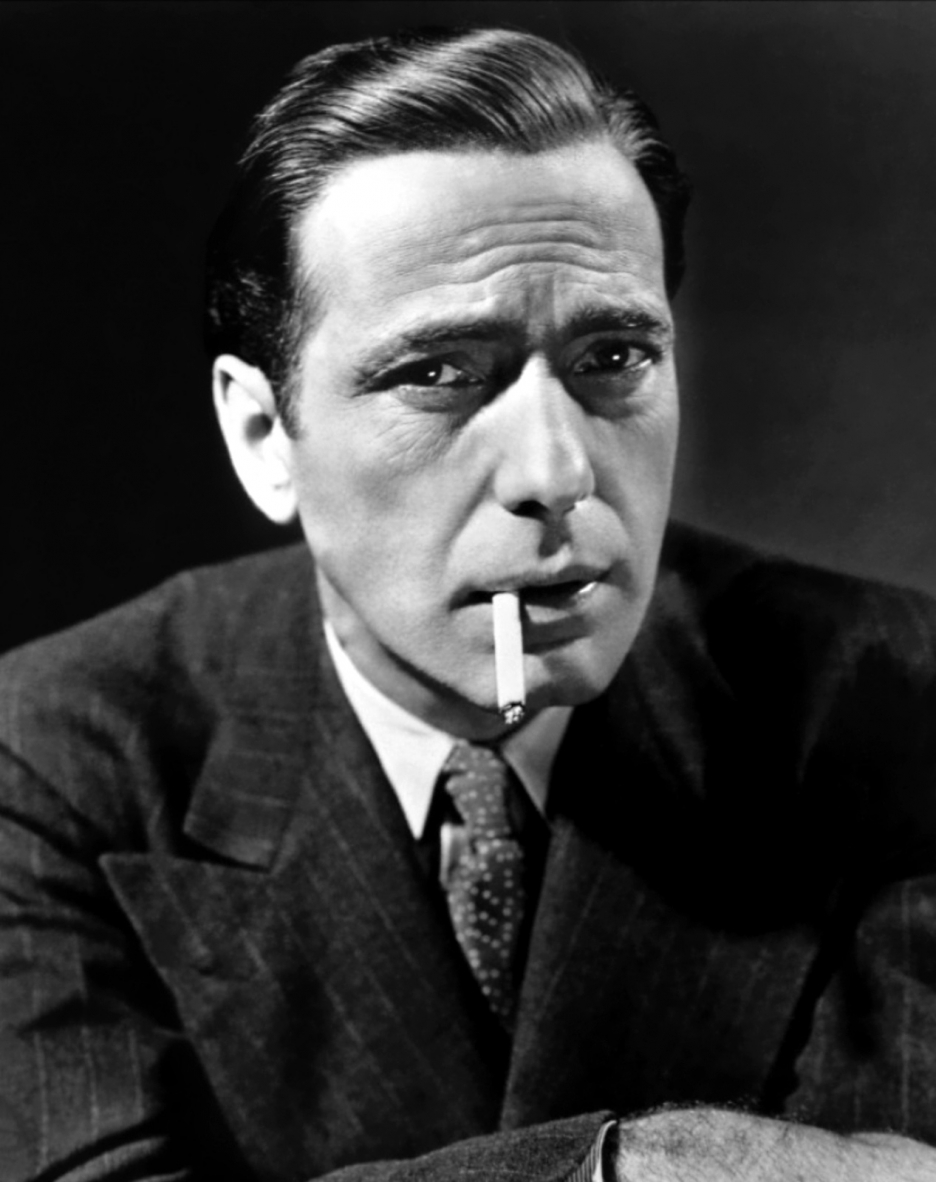
Bogart Bogarting
Specifically, I want to discuss two films that produced probably his most famous roles:

  • The Maltese Falcon (Nominated 1941)
  • Casablanca (Won 1943)

In The Maltese Falcon, Bogart plays private detective Sam Spade, aka the basis for every other noir detective character, whether ironic or not. There is no Eddie Valiant (Who Framed Roger Rabbit), Jake Gittes (Chinatown), Tracer Bullet (Calvin & Hobbes), Dean Corso (The Ninth Gate), Doc Sportello (Inherent Vice -- OK, this may be a stretch) etc., etc., etc. without Sam Spade. He is written as a shiftless, no-scruples type of guy who somehow manages to stay one step ahead of his rivals, except when he doesn't, and even then, he manages to get out of trouble with little more than a bump on the noggin. The cops are not his friends, but they aren't out to get him either. Women are equal-parts repulsed and drawn to his droopy-eyed, vague-faced attitude.

Oh, and the movie itself is about some people trying to find a statue that, supposedly, is worth upwards of ONE MILLION dollars (in Dr. Evil voice). Allegiances and motives are turned upside down and backwards among a shifty cast of characters, including Peter Lorre and Sydney Greenstreet (both of whom also appeared as cinematic stick figures in Casablanca). But, really, it is not important what happens. All that matters is what Sam Spade says, how he says it, and how cool he is. No, really. I do believe that's what this movie amounts to, and despite being rather one-dimensional, it is pretty good. Here is one of my favorite scenes:


This was my first experience with director John Huston, and other Huston installments will be upcoming throughout this project, e.g. The Treature of the Sierra Madre (also a Bogart vehicle), and Moulin Rouge (1.0). The Maltese Falcon did not win Best Picture in 1941, as that honor went to Mrs. Miniver

Score for The Maltese Falcon: 7.5. 

Now, we arrive at a discussion regarding one of the most personally conflicting movies of this project to date. A little movie called... Casablanca

This movie is about an exiled American nightclub owner in early 1940's, quasi-occupied Casablanca, Morocco, who has somehow risen to a vague but meaningful level of influence among both authorities and underground figures. That man's name is Rick Blaine, easily Bogart's most famous and historically significant character (although I think Sam Spade is better). Blaine's former lover Ilsa Lund (Ingrid Bergman) arrives in Casablanca with her husband, Victor Laszlo, a leader of the Czech Resistance. To make a longer and more complicated story short: Casablanca is where you need to be if you want to escape occupied Europe, and Blaine has the means for such an escape. He spends most of the film conflicted over (1) his love for Ilsa and (2) his fleeting support of anti-fascist causes, and in the end, he chooses the latter, much to the weepy chagrin of Ilsa. 

This was the first time I'd ever seen Casablanca from start to finish. (Gratuitously extraneous detail: I got to see it while chowing on a four-course, Moroccan-inspired menu, complete with wine pairings, thanks again to the best place in the universe, The Alamo Drafthouse.) This movie makes the very short list of one that I've consistently seen near the top of every "All Time Best" list. I knew all the famous quotes, e.g. "here's lookin' at you," "beautiful friendship," "play it Sam" (not "play it again," nobody ever says that), "of all the gin joints," etc. To say that I came into watching this movie with high expectations would be an understatement. I came into this movie expecting to walk out, with tears in my eyes, wanting to rush back to my seat and demand that it be played again from the beginning. 

But that didn't really happen. 

Don't get me wrong! This is a great film. It is a clinic in writing, and has one of the best closing scenes ever in a movie.  But aside from that scene, and possibly the wonderful flashback sequence showing Blaine's and Ilsa's happier times in Paris, I thought that the movie was rather shiftless. Most of the movie takes place inside the nightclub and consists of boring, explanatory dialogue. The supporting cast is very caricature-ish, especially poor Sam and Renault. Bogart acts like Bogart, which is fun if you've never seen any of his other movies, but don't put Rick Blaine and Sam Spade side-by-side and tell me that Spade is not a far superior character. In the end, Bergman, for me, is probably the acting highlight of the film. She is really wonderful, and I'm looking forward to seeing her in Gaslight.

Is Casablanca very, very good? Yes. Is it among the best movies of all time? Not even close.

I've searched the Net high and wide for cinephiles who share my conflict. There are many. There is one writer in particular who I think summed it up best, and excuse me if I paraphrase, but the gist of his notion was that Casablanca might be more "lovable" than it is actually good. This movie has become a sort of idealized notion of old Hollywood, and I think it gets a lot of breaks for that reason. If there's anything I have learned in this project, it's that not all pre-1950's, black-and-white movies are as boring and dialogue-driven as Casablanca. They don't all need to feature wooden, barely believable romances, either. I think we're allowed to expect a little more of a movie that many say ranks among Citizen Kane, The Godfather, Lawrence of Arabia, etc., as one of the best ever made. 

For the five people reading this, I invite you to disagree with me and tell me why. These views are subjective and inclined towards certain tastes. But I've been watching a lot of movies from a lot of different decades, and simply do not see the basis for universal, outright, adulation. 

Casablanca won Best Picture in 1943, and I have yet to see any of the nine other films that it beat out. But I will probably watch those with an extra careful eye towards comparison. I will give this movie a score fitting of one that is very good, even great, but not nearly an all-time best: 8.4.